I. H. A. Alsaleh

Power & energy systems · University of Hail

Ibrahim H. A. Alsaleh

Associate Professor of Electrical Engineering · University of Hail, Saudi Arabia

Optimization, control and stability for power grids that run more and more on inverters, storage and flexible demand.

898citations
16h-index
22i10-index
Google Scholar, Oct 2026
Portrait of Dr. Ibrahim Alsaleh
Hail, 2023

About

Dr. Alsaleh works on the mathematics of operating electric grids: how to optimize them, how to control them, and how to keep them stable as solar generation, batteries, electric vehicles, flexible loads and inverter-based resources take over roles once held by large synchronous machines.

His doctoral work at the University of South Florida, supervised by Lingling Fan, produced convex optimization models for voltage regulation in PV-rich, multi-phase distribution systems. At the University of Hail, where he has held academic positions since 2013, the work has widened in two directions: toward electricity markets and data-driven control of demand-side flexibility, and toward the dynamics of grid-following and grid-forming converters, wind generators and low-inertia networks.

He led the NeomFlex team that won the NEOM AI Challenge in 2023, teaches courses that move from circuit theory to converter control, and works closely with a network of collaborators in Saudi Arabia and abroad.

Position
Associate Professor, Department of Electrical Engineering, University of Hail (2025–)
Ph.D.
Electrical Engineering, University of South Florida, 2020
Focus
Distribution optimization · demand flexibility · DRL for grid control · IBR, GFL/GFM and DFIG dynamics
Tools
Python · MATLAB · GAMS · CVX · YALMIP · MOSEK · Gurobi

Research

Three strands of one problem

Each strand tackles a different part of a grid in transition: how distribution networks are dispatched, how flexibility is priced and controlled, and how converter-dominated systems behave dynamically. Each opens with the methods it relies on and a few representative papers.

How should a power system be optimized and controlled when its behavior is set less by rotating machines and more by power electronics, distributed resources and data?

PHASE A · 0° 2018 – 2021

Optimizing unbalanced distribution networks

Real distribution feeders are multi-phase, unbalanced and full of discrete devices such as voltage regulators and capacitor banks, which makes the AC optimal power flow problem nonconvex and mixed-integer. This line of work builds convex formulations that still respect that physics: semidefinite and mixed-integer SDP relaxations for volt/var optimization, multi-period co-optimization of regulators and PV inverters, and a convex-iteration method that recovers exact solutions from an extended radial ACOPF model.

SDP relaxationMISDPconvex iterationthree-phase ACOPFvolt/var control
  • Selected
  • Extended radial distribution ACOPF model: retrieving exactness via convex iterationIEEE Trans. Power Systems, 2021
  • Multi-time co-optimization of voltage regulators and photovoltaics in unbalanced distribution systemsIEEE Trans. Sustainable Energy, 2021
  • Mixed-integer SDP relaxation-based volt/var optimization for unbalanced distribution systemsIEEE PES GM, 2019

PHASE B · −120° 2018 – 2025

Markets, flexibility and learning at the grid edge

Once a distribution network can be dispatched, the next questions are how to price it and how to make demand respond. The papers here develop distribution locational marginal prices for multiphase systems, convex bilevel models of day-ahead distribution markets, a bi-level primal-dual model that couples price-based demand response with DLMP, and rank-penalized SDP for flattening net load.

Where a full grid model is unavailable or too slow for real-time use, the work turns to model-free deep reinforcement learning: first a single agent for demand response in a PV-rich feeder, then decentralized multi-agent control in NeomFlex, and curriculum-trained multi-agent RL for energy adequacy in active distribution networks.

DLMPbilevel / primal-dualdemand responseSAC · PPOmulti-agent RLcurriculum learning
  • Selected
  • Optimizing local electricity markets: a bi-level primal-dual approach for integrating price-based demand response and DLMPAin Shams Engineering Journal, 2024
  • Curriculum learning-based multi-agent reinforcement learning for coordinated energy adequacy in active distribution networksIEEE PES GM, Austin, 2025
  • Optimal net load flattening in unbalanced distribution systems via rank-penalized semidefinite programmingIEEE Access, 2023
  • Distribution locational marginal pricing (DLMP) for multiphase systemsNAPS, 2018
PHASE C · +120° 2017 · 2023 – 2026

Dynamics of inverter-dominated grids

As converters replace synchronous machines, stability depends on control loops: phase-locked loops, current limiters, droop and inner current controllers. Recent work, largely with Abdullah Alassaf, builds and analyzes dynamic models of these devices: numerical state-space models of grid-following resources, a 26-state nonlinear DFIG model and its equilibrium structure, DFIG low-voltage ride-through in weak grids with PLL effects and crowbar limits, blade-pitch dynamics, and wind-farm parameter identification with dynamic mode decomposition.

For grid-forming converters, the focus is current limiting: modal analysis of converters with projection-based limiters, and a constraint-activated, projection-free control law for power-limited droop-controlled networks.

state-space & modal analysisPLL / weak gridsGFL · GFMDFIGDMDc identificationcurrent limiting
  • Selected
  • Identifying wind farm parameters via dynamic mode decomposition with controlIEEE Trans. Industrial Informatics, 2025
  • Constraint-activated projection-free control for power-limited droop-controlled grid-forming networksMathematics, 2026
  • DFIG low-voltage ride-through in weak grids: rotor overcurrent, PLL effects, and crowbar boundariesInt. J. Energy Research, 2026
  • Grid-following inverter-based resource: numerical state–space modelingSustainability, 2023

Collaboration

A wide collaborative network

Alongside his own lines of work, Dr. Alsaleh contributes to collaborative studies with groups led by H. M. Hasanien, A. M. Shaheen, S. Kamel, H. Alafnan and others, on optimal power flow under renewable and EV uncertainty, reactive power dispatch, battery and fuel-cell parameter estimation, solar forecasting and superconducting fault-current limiters. Co-authors on the Scholar profile include Lingling Fan (USF), Junbo Zhao (Dartmouth) and Abdullah Alassaf (University of Hail).

Most-cited papers · Scholar, Oct 2026

  1. 138Enhanced coati optimization-based OPF including renewable uncertainties and EVs. Energy, 2023
  2. 111Hybrid PSO–sea horse optimal reactive power dispatch with EVs. Energy, 2024
  3. 78Li-ion state-of-health estimation with dual adaptive UKF and Coulomb counting. J. Energy Storage, 2024
  4. 54Probabilistic OPF with renewables via enhanced walrus optimization. Ain Shams Eng. J., 2024

Selected project · 2023 – 2025

NeomFlex: toward an AI-driven grid

NeomFlex won the NEOM AI Challenge in 2023, a global competition on using data-driven AI for projections and decision support, which came with a contract with NEOM. Dr. Alsaleh led the team as principal investigator.

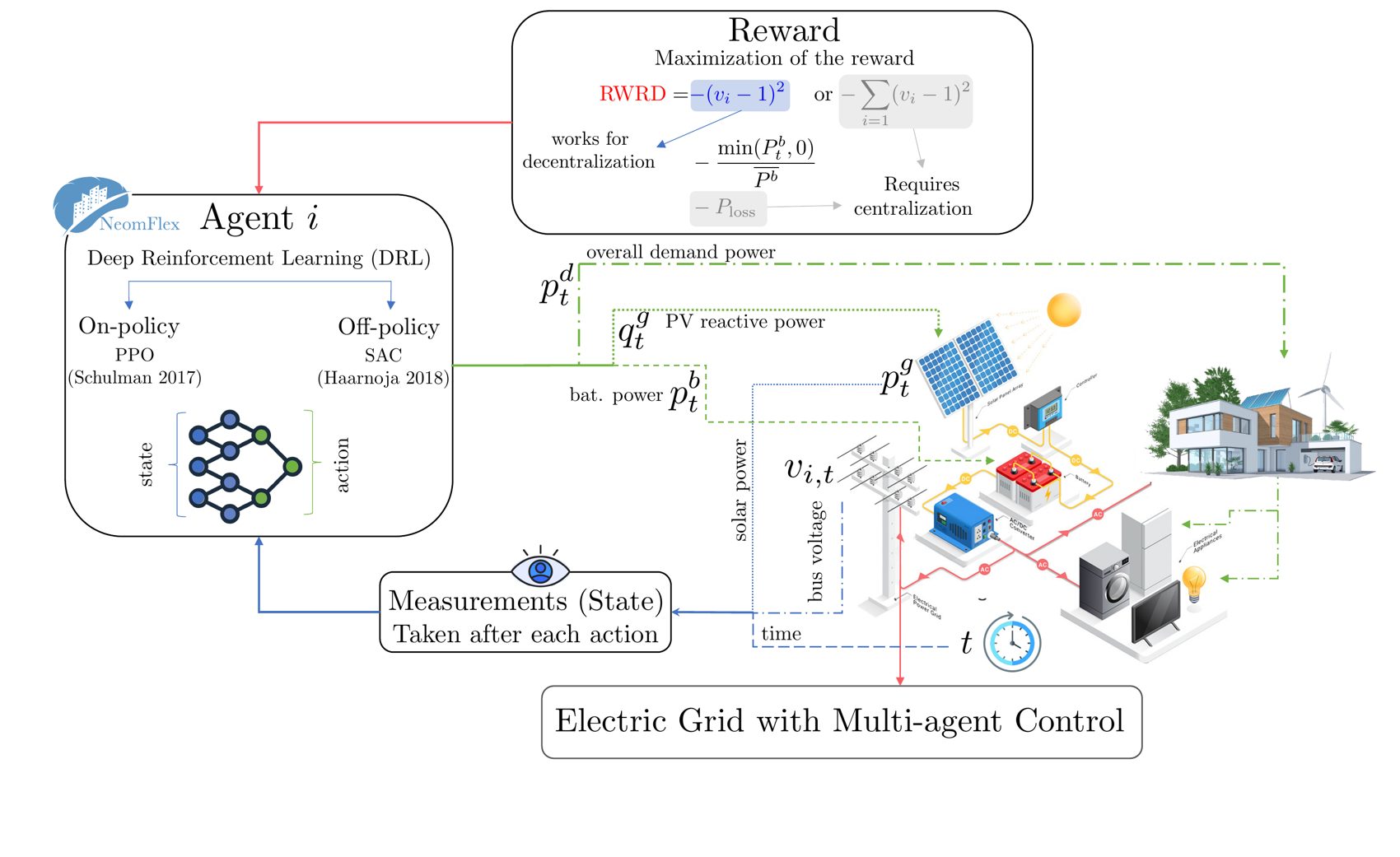
The project asked how a future city grid with a large share of solar generation could keep voltages within limits and use its renewable energy well without a central controller that needs a full model of the network. The answer the team built is a set of deep reinforcement learning agents, one per territory of the feeder, that dispatch batteries and PV reactive power using local measurements only.

Principal investigator · team leader
Dr. Ibrahim Alsaleh
Co-PI
Dr. Abdulaziz Almalaq
Co-PI
Dr. Abdullah Alassaf
Consultant
Dr. Zoltan Nagy
Dr. Alsaleh holding the award trophy at the 2023 ceremony
Dr. Alsaleh on stage with the trophy
Dr. Alsaleh with two colleagues at the ceremony

Recognition ceremony, Hail Region, December 2023.

  1. 2023Challenge won

    NeomFlex selected as winner of the NEOM AI Challenge.

  2. Feb 2024Month-1 report

    Scope, requirements, DRL literature review and testbed design.

  3. Jun 2024Model deep dive

    Agent types, grid and training data, decentralized layout.

  4. Dec 2024Final presentation

    “A grid-aware energy adequacy model”, tested on 15-day profiles.

  5. 2025Research paper

    Curriculum-learning multi-agent RL for energy adequacy, IEEE PES GM, Austin.

How the agents work

  1. Territories. The feeder is split into territories, each with its own agent controlling local batteries and PV reactive power. Agents do not communicate with each other.
  2. Observation. Each agent sees only local states: bus voltage, solar power, demand and time of day.
  3. Reward. An agent is penalized when consumer voltage leaves its limits and when batteries charge or discharge poorly. The local voltage term is what allows decentralization; a network-wide loss term would require a central view.
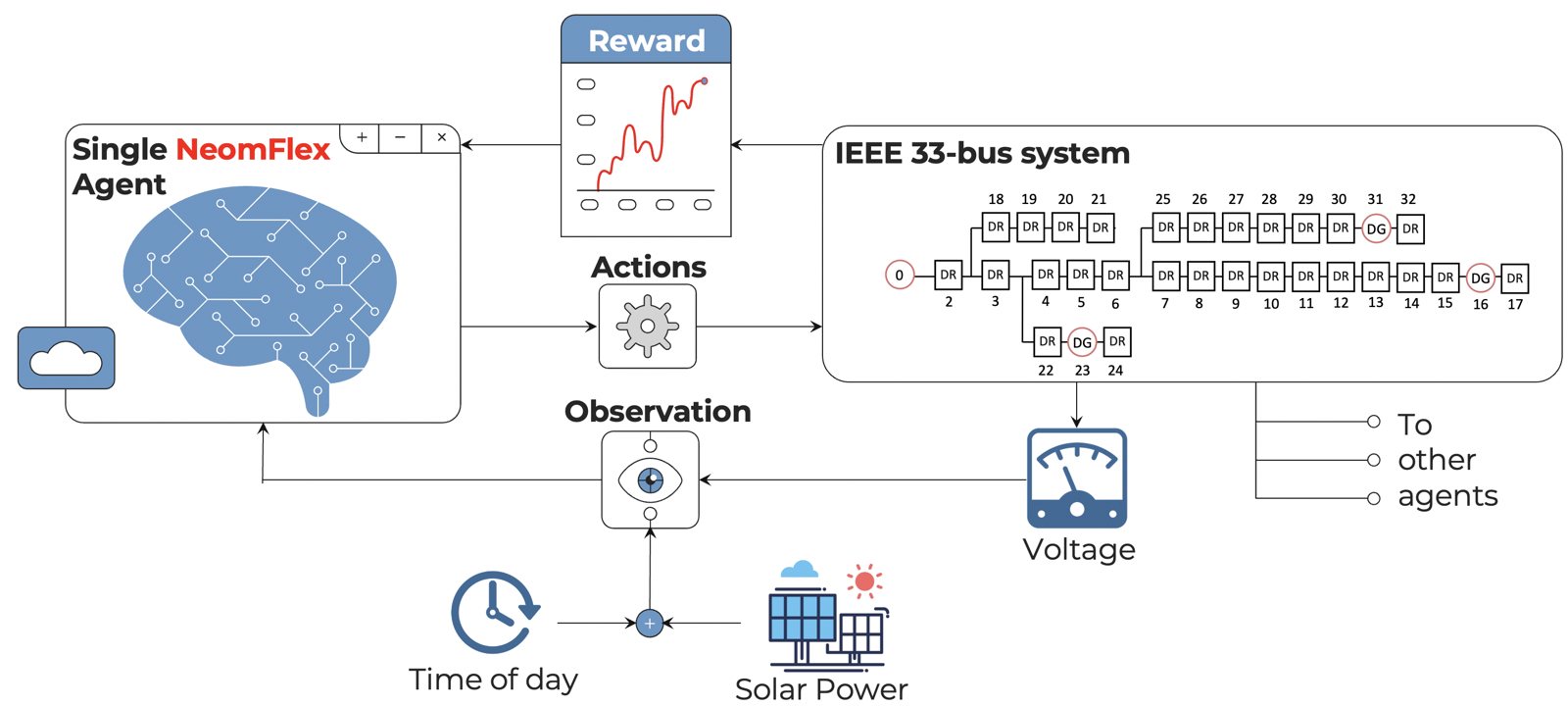
  4. Training. The environment is a power-flow simulation (PandaPower) of the IEEE 33-bus system driven by real-world demand and solar profiles. Agents use soft actor-critic, with curriculum learning to stage the difficulty.
  5. Deployment. Once trained, the agents need no model of the grid and no load forecasts, and can be retrained as the grid grows.
NeomFlex agent diagram: DRL agent, reward, measurements and the electric grid with PV, battery and loads
A single NeomFlex agent acting on the IEEE 33-bus system

FIG 1One agent in the loop: actions on the IEEE 33-bus feeder, voltage and solar observations back, and the reward that shapes the policy.

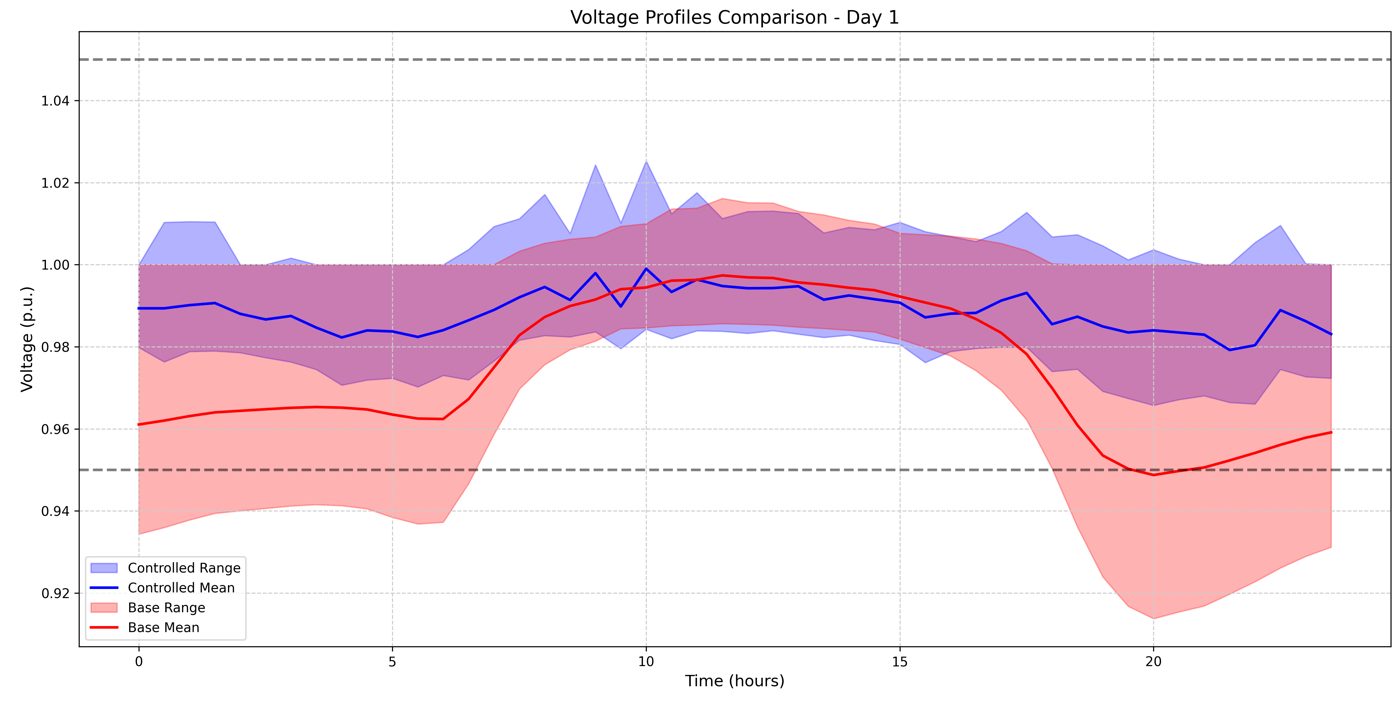
Voltage profile comparison on test day 1, with and without NeomFlex control

FIG 2Test day 1 from the project code: range and mean of bus voltages with agent control (blue) and without it (red). Dashed lines mark 0.95 and 1.05 p.u.

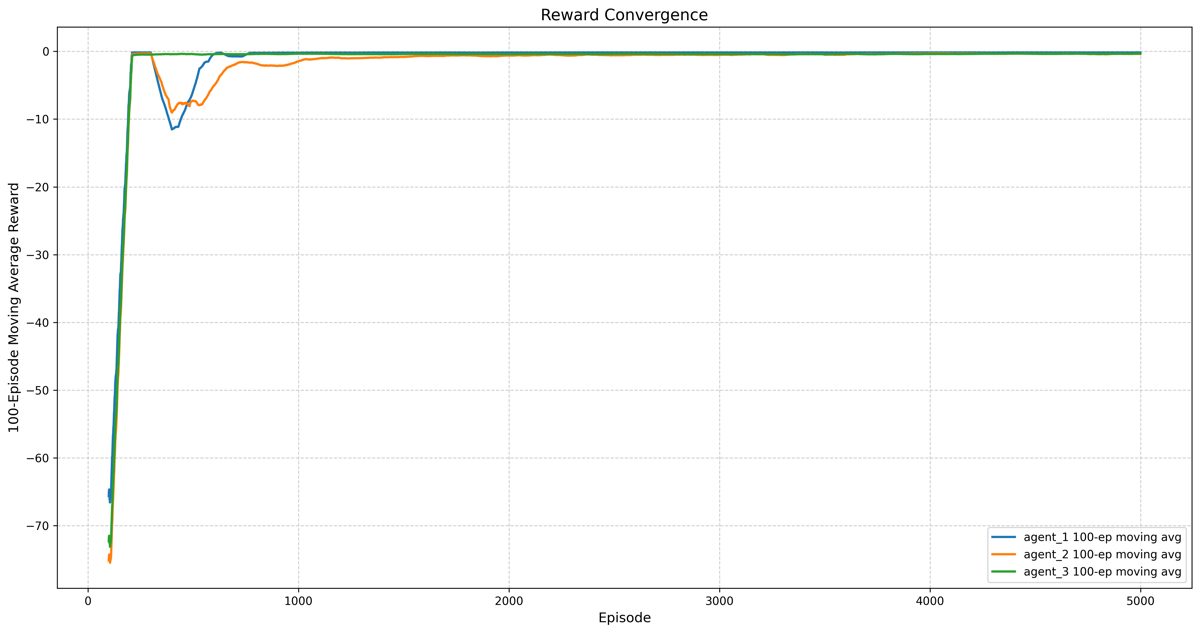
Reward convergence of three agents over 5000 episodes

FIG 3Training: 100-episode moving-average reward of the three territorial agents over 5,000 episodes.

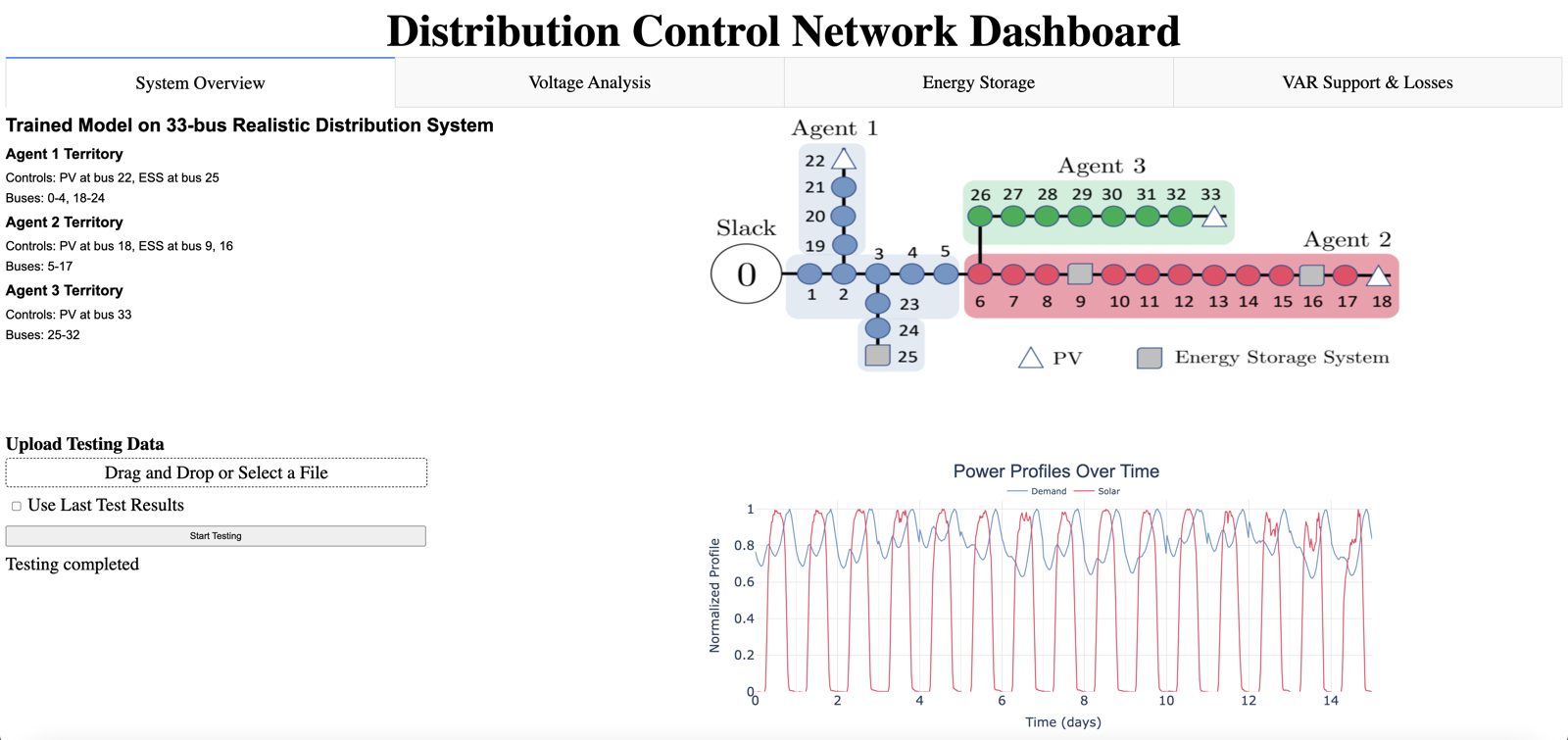
Prototype distribution control dashboard showing three agent territories

FIG 4Prototype of the utility dashboard proposed in the final presentation, showing agent territories, PV and storage locations, and test profiles.

Teaching

From circuit laws to converter control

The same habit runs through teaching and research: write the model, then run it. Lecture slides are written in LaTeX, figures come from Python code the students can read, and senior courses end with students simulating a small converter-based network themselves.

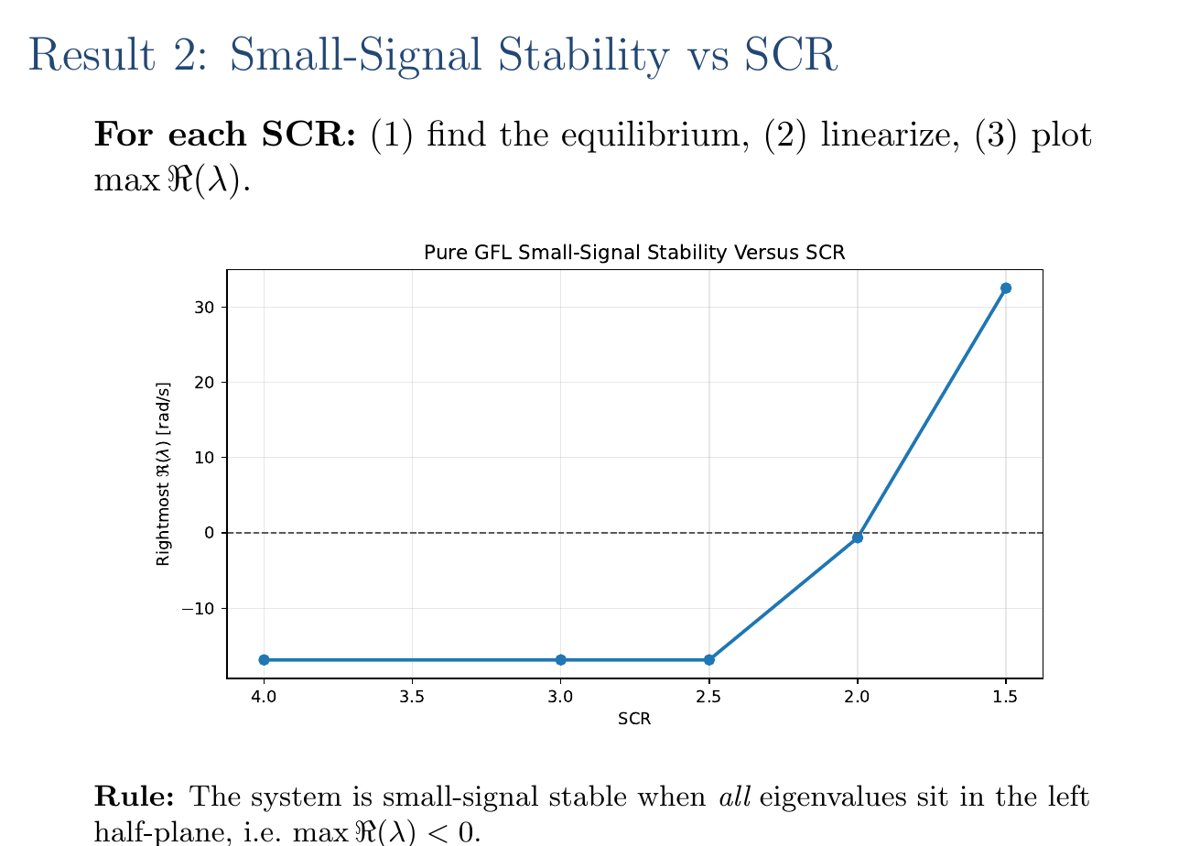
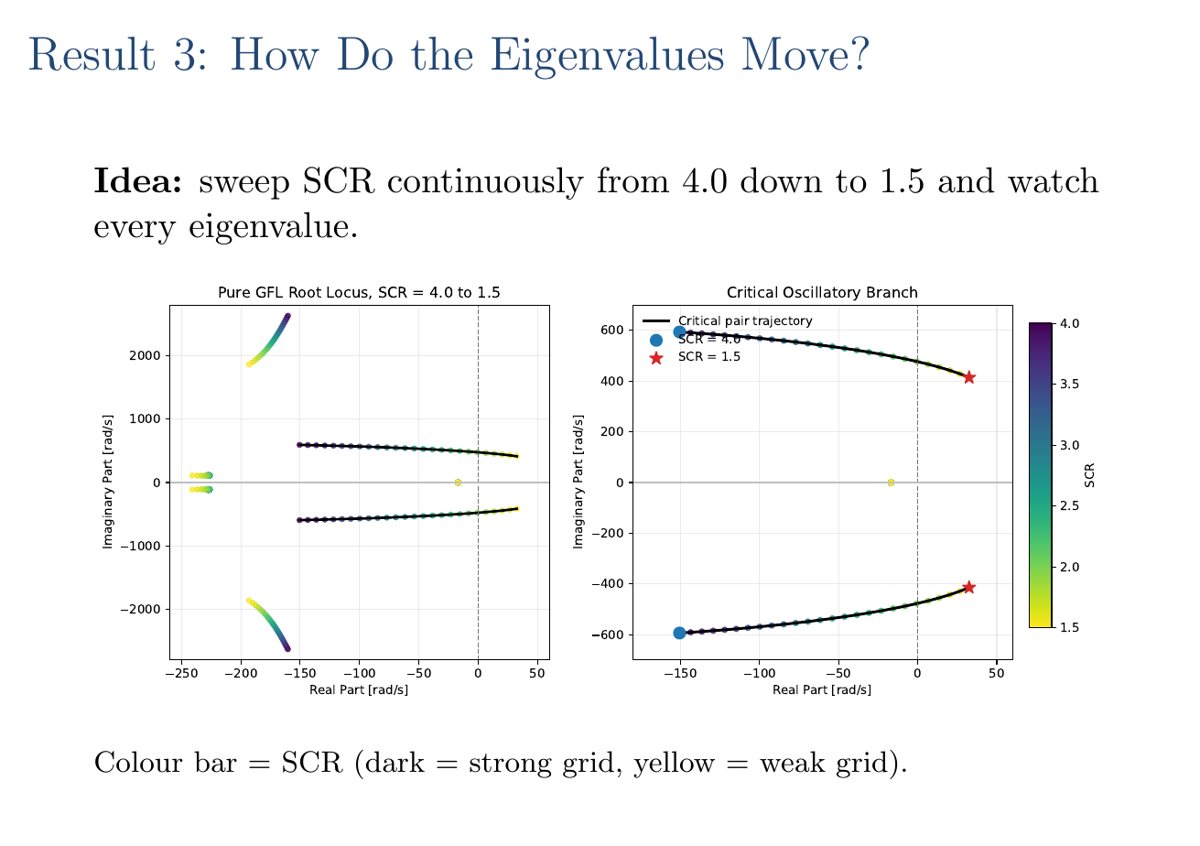
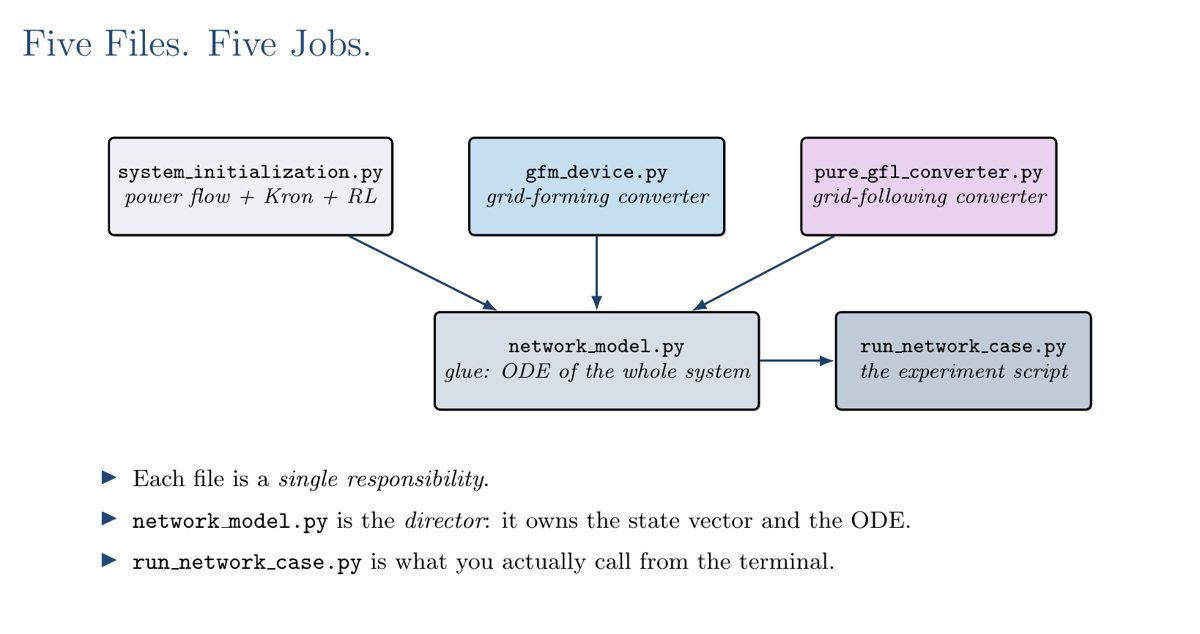
Slide: small-signal stability of a grid-following inverter versus short-circuit ratio Slide: eigenvalue migration as SCR decreases Slide: the five Python files of the two-GFM, one-GFL course project
REE-404 · senior renewable energy engineering

Energy Generation and Control

Starts with the swing equation, single-machine infinite-bus transient stability and governor frequency control, then moves to the modern grid: inertia and RoCoF, half-bridge converter control, dq transformation, PLLs, grid-following versus grid-forming inverters, and the stability of a GFL inverter as the grid weakens. The course project builds a real network with two grid-forming and one grid-following converter in Python, step by step.

swing equationsmall-signal stabilityGFL · GFMPLLSCRPython
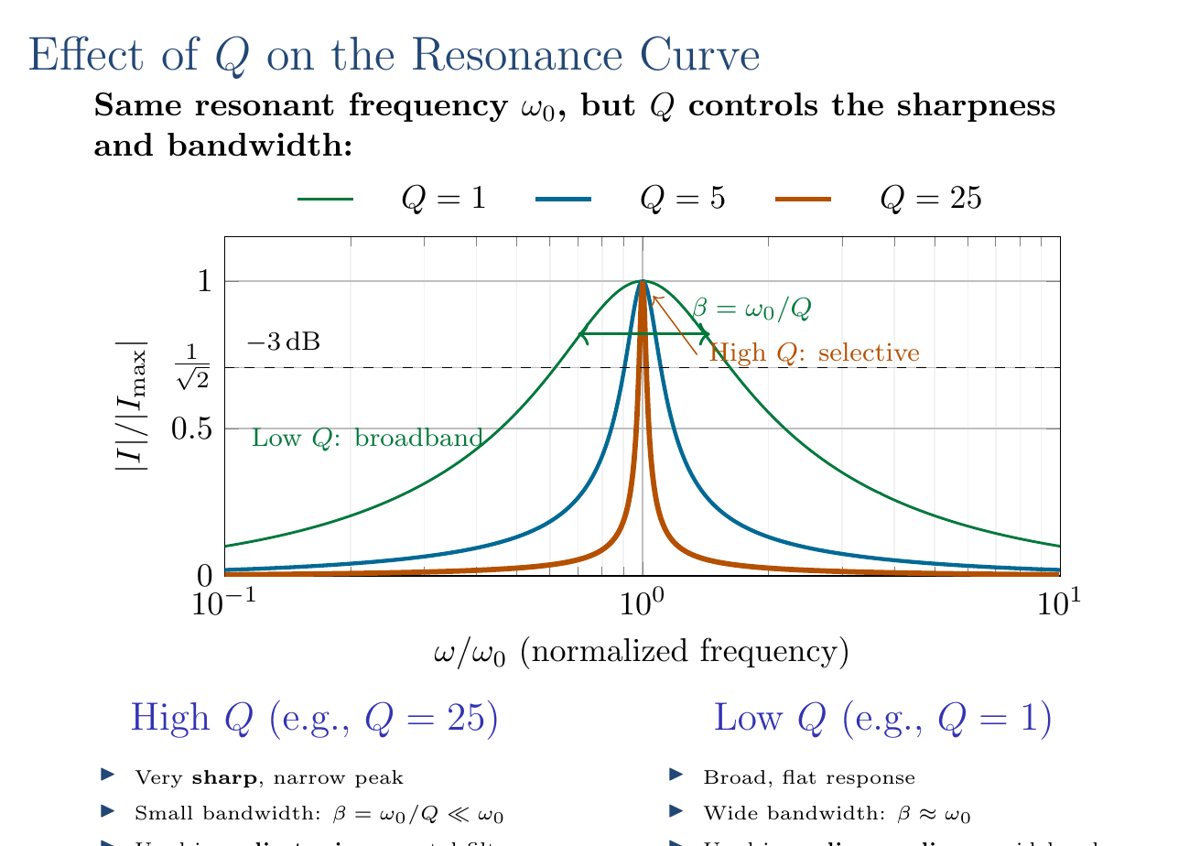
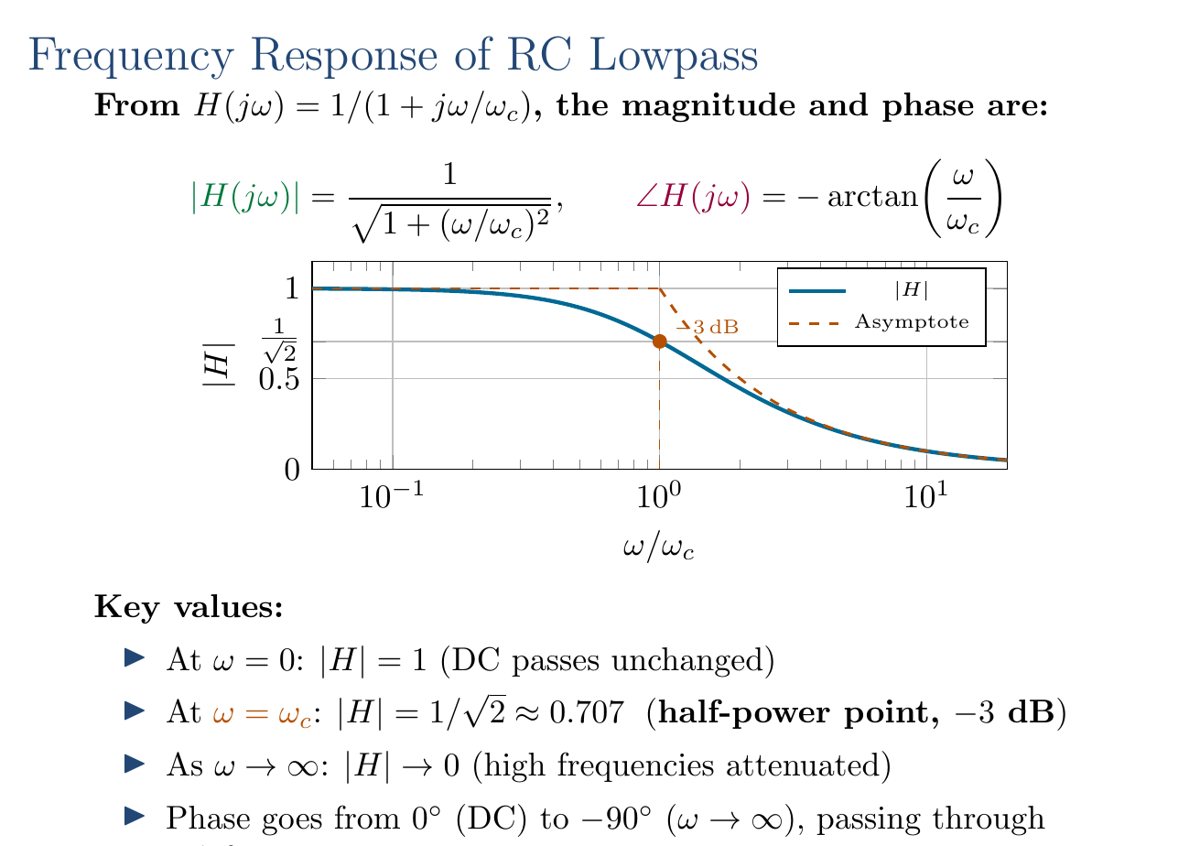
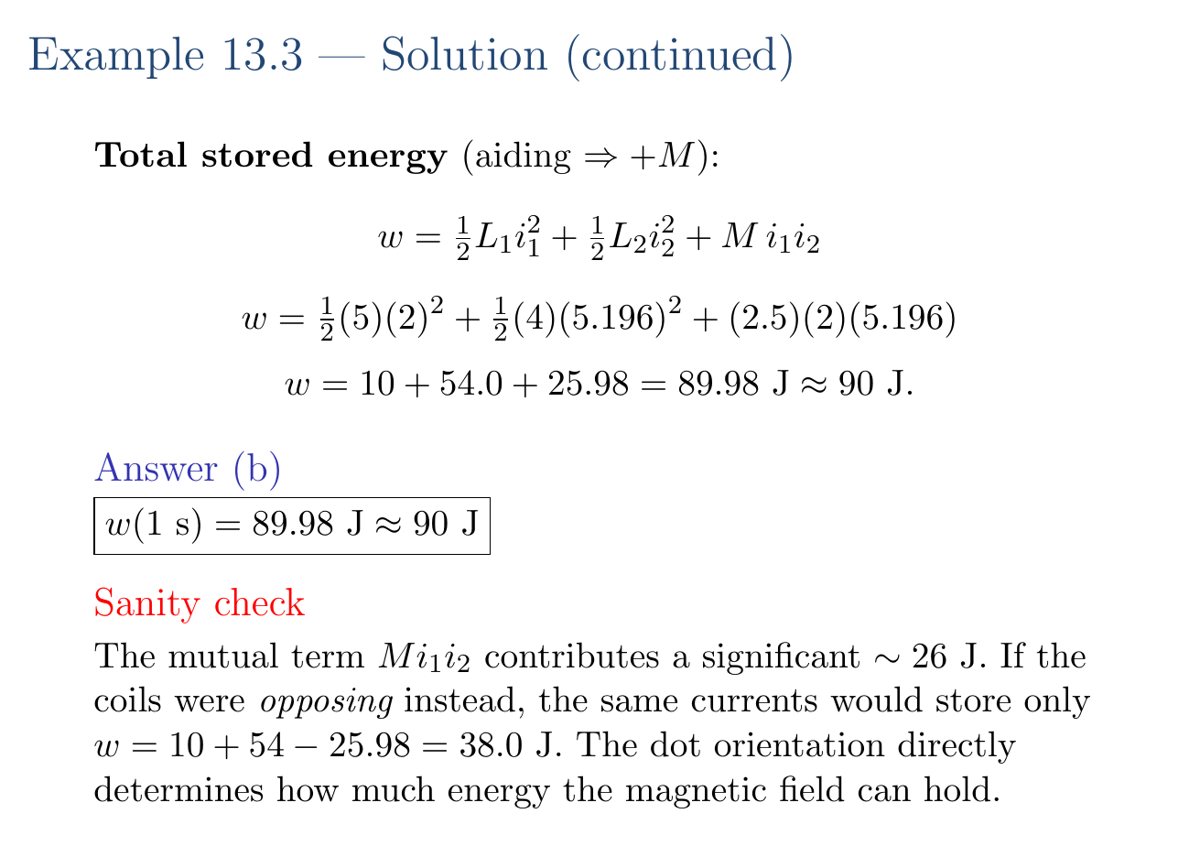
Slide: effect of Q on the resonance curve Slide: frequency response of an RC low-pass filter Slide: worked example on energy stored in coupled coils
EE205 · EE202 · electrical engineering core

Electric Circuits

Electric Circuits II covers sinusoidal steady-state power, balanced three-phase circuits, frequency response with Bode plots, resonance and filters, and magnetically coupled circuits, each chapter with its own slides, problem sets and quizzes. Fundamentals of Electric Circuits (EE202) lays the groundwork, with short video lessons for each chapter.

AC powerthree-phaseBode & resonancefilterscoupled coils

Classroom model

What happens to frequency when inertia leaves?

A load step hits a 60 Hz system. Replace synchronous generation with inverters that supply no inertia or fast frequency response, and watch the rate of change of frequency and the nadir.

Inertia H
5.0 s
Initial RoCoF
−0.60 Hz/s
Nadir
59.6 Hz

Aggregated swing equation 2H·dΔf/dt = ΔPm − ΔPL − D·Δf with droop governor (R = 5 %, D = 1, governor 0.2 s, turbine 0.5 s). H = 5 s × synchronous share. Faded trace: all-synchronous case. The REE-404 lectures build this model from first principles.

Publications

Complete record

All journal articles, conference papers and the dissertation listed on Google Scholar. Filter by research strand or search by title, co-author or venue.

    Academic journey

    Hail, Tampa, and back

    Positions & degrees

    2025 –
    Associate Professor of Electrical Engineering

    University of Hail

    2021 – 2025
    Assistant Professor

    University of Hail. Principal investigator of research groups on IBRs and demand-side optimization, and on machine learning for power system control.

    2016 – 2020
    Ph.D., Electrical Engineering

    University of South Florida, Tampa. Dissertation: Comprehensive Optimization Models for Voltage Regulation in PV-Rich Multi-Phase Distribution Systems. Supervisor: Dr. Lingling Fan.

    2017 – 2021
    Lecturer

    University of Hail

    2014 – 2016
    M.S., Electrical Engineering

    University of South Florida, Tampa

    2013 – 2017
    Teaching Assistant

    University of Hail

    2007 – 2012
    B.S., Electrical Engineering

    University of Hail

    On the conference circuit

    2017 – 2019North American Power Symposium

    Droop control, volt/var optimization, multiphase DLMP, distribution markets

    2019IEEE PES General Meeting

    Mixed-integer SDP volt/var optimization

    2024 · SeattleIEEE PES General Meeting

    Presented work in Seattle

    2025 · AustinIEEE PES General Meeting

    Curriculum-learning multi-agent RL for energy adequacy

    2022Saudi Arabia Smart Grid

    Model-free RL for demand response

    2026 · ChengduICPET 2026

    International conference, Chengdu, China

    OngoingIEEE PES task forces

    IBR oscillations, RMS modeling of IBR controls, DRL for dynamic system control

    2021 –National Innovation Challenge (Asf)

    Board member

    Service

    University Scientific Council

    • Research Excellence Reward Committee2021 –
    • Promotion Sorting Committee for faculty members2023 –
    • Faculty Appointment Committee, assistant professors2021 – 2023
    • Contract Extension Committee2022 – 2023

    Department of Electrical Engineering

    • Research Excellence Reward Committee2022 – 2023
    • IEEE Chapter and Student Activity Committee2021 – 2023
    • Supervision of undergraduate and graduate projects

    Professional

    • Member of IEEE PES task forces on IBR oscillation investigation, RMS modeling of IBR controls, and deep reinforcement learning for dynamic system control
    • Researcher, collaborative group on superconducting fault current limiters for power system stability2021 –